I gotta come up with better titles for these things . . .
I decided to dig out my copy of Sherlock Season 2, and watch The Reichenbach Fall again, and something struck me while I was watching the scene where Moriarty comes to Baker Street just after the announcement of his acquittal. He mentions a problem to Sherlock. Their problem. The 'final problem.' When I initially watched this, I took it as meaning that Moriarty's final problem was how to best ruin Sherlock's reputation. But what if that's not it at all? I'm wondering now if his final problem was how to ruin Sherlock's reputation before committing suicide and therefore dying as a martyr.
I never noticed before . . . The Grimm Brothers Fairy Tales book that Sherlock looks at in the school after the kids are kidnapped is in the same kind of packaging that the bread crumbs outside Baker Street that John picked up were in.
Once again, I apologize, I'm writing this as I watch.
"All fairy tales need a good old fashioned villain."
I keep coming back to that. There's got to be something in one of those fairy tales that parallels this story!
Oh, my God . . . I just realized . . . The assassins that moved in within spitting distance of 221B Baker Street . . . I thought they were more of Moriarty's men, stationed there to close the web around Sherlock. What if the opposite's the truth? What if they went there of their own volition in order to protect Sherlock? I just passed the part where the one guy saved Sherlock from being hit by the car and then is killed when Sherlock shakes his hand. Sherlock comments on it, on them being there to keep him alive because he has something they want. But what if that's not entirely true?
Just reached the part where Sherlock and John escape, and where Sherlock says, "I'm doing what Moriarty wants. Becoming a fugitive. Run."
He knew what the game was. He knew Moriarty was like a spider, controlling thousands of strings of a web, knowing exactly what buttons to push to make whatever happen. And he knew that Moriarty was trying to destroy him inch by inch. He said that, minutes before in the episode.
And yet, he plays into Moriarty's hand there, doing what Moriarty wanted him to do. Why? Why would he play into his hands like that? Why run from the police, making things worse for himself (and John) instead of just dealing with whatever questions, and probably being released the next day? Cuz if Sherlock is intelligent enough to solve the crimes, he's intelligent enough to figure out how to prove that no, he wasn't involved. Why didn't he do that, instead of playing into Moriarty's hands?
"There's only one thing he needs to do to complete his game and that's to--"
I think I'm right. Moriarty knew there would be a final confrontation between him and Sherlock and he knew he was going to die. And if he died when Sherlock's reputation was in tatters, he'd die a martyr. He'd die as someone revered, because he'd die as Richard Brook, the 'actor Holmes hired.'
I still don't buy everyone's explanation for why he needed Molly. I'm still not convinced that she was in on helping him fake his death. That kind of deception, especially that big of one for that long-term just doesn't fit her character. I don't think she'd be able to keep up the illusion. I still think she was asked to help restore his reputation, or something of that nature.
I think the gunmen could hear him. I think part of the last step of things was Sherlock's own voice telling someone he was a fraud, and that, along with seeing him go off the rooftop, was what stopped the snipers.
This episode confuses the Hell out of me, to be honest. I don't know what to make of it. I come up with a new thought, and it contradicts something else I thought I'd figured out.
God, I can't wait for Season 3!
Showing posts with label Benedict Cumberbatch. Show all posts
Showing posts with label Benedict Cumberbatch. Show all posts
Tuesday, February 19, 2013

Friday, February 8, 2013
The Reichenbach Fall
Okay, so I've recently been watching some hilarious song related YouTube things of Sherlock, and found a couple tonight that talk about how he faked his death. The one I'm currently watching mentions the black ball that he's bouncing against the wall before he goes to the roof to meet Moriarty. People have said that Sherlock would have no noticeable pulse if he stuck that ball under his arm and held it there. Except, watch the ending of that episode. Watch him up on the roof with Moriarty, and then when he's standing there, after dropping the phone. There's no way that with all that movement, that the ball idea would still be a valid one.
I'm ready to dig out the episode again. For one thing, I wanna see if I can get a good look at the biker. Someone suggested that that was actually Sherlock, but I'm doubting it. However, someone else mentioned an original Holmes story, the Priory School? Something like that, that has a plot similar to the kidnapped children in this episode.
I must speculate further . . .
God, I can't wait till season 3. I swear, I don't care if I can only play them on my computer, I'm gonna buy the next season off amazon UK when it comes out so I don't have to wait five months before the episodes come to America.
Tuesday, May 22, 2012
The Reichenbach Heartbreak - BBC Sherlock's Third Episode

SPOILERS AHEAD.
So yeah. If you've somehow missed these episodes (I don't know what rock you'd be living under to have accomplished that, but still,) then read with caution. I spoil the ending, I talk about my theories, and I swear to God, I will put money on this, I'm positive I've found the clue that everyone's missed. I don't know how it fits in with Sherlock faking his death, but I'm sure I know what the missing clue is. I'll develop further theories to that aspect once I have the DVD in my hands and can watch it a bazillion times.
I cried. I freely admit it. I cried when Sherlock called up John and told him that everyone was right. That Sherlock was a fraud, and that John should tell Mrs. Hudson, Lestrade, everyone, because the papers were right.
And I cried again when John was at the grave.
I haven't gone into much detail about the performances of the actors in past blogs, but I'd like to now. I think Martin Freeman's performance throughout this episode was amazing, but his true shining moment was at the grave. From the start, we see him trying to be tough, cold, not to let his emotions take over. His speech, therefore, was somewhat stilted, not over-flowing with emotion, like we would normally see of one at a gravesite, who is overcome by what they're in front of. What the world they're suddenly facing will be like. Let's face it: John Watson was trying to be like Sherlock always was. A machine. Separating himself from caring because he didn't see it as a worthwhile means to an end.
But that facade fades as he speaks. As he asks Sherlock for one final favor: to not be dead. I think this was Martin Freeman's crowning achievement so far for this series. He's been absolutely amazing thus far, but that scene . . . It was just so powerful, so well done, and so moving. I wish I could do it justice by description, but I think even if I filled up a novel, writing about those, maybe, two minutes, I still wouldn't be able to.
Benedict Cumberbatch's Sherlock is incredible. The sheer amount of effort that must go into him so flawlessly executing the deductions, the aloofness, everything, and making it seem effortless is nothing short of remarkably amazing.
I have to say, I think my two favorite parts of this episode with Benedict Cumberbatch were his reactions to Molly's thoughts about him during the "You look sad...when you think he can't see you," bit, and his acting on the rooftop. Specifically, when he says, "Oh, I may be on the side of the angels, but don't think, for one second, that I am one of them." And then, of course, when he's on the phone with John.
Honestly, as far as what I think the clue everyone missed is, I'm not going to say right now. I'm going to wait until I have the second season DVD in my hands and I can watch all six in a row. Nine hours of Sherlock. I'll be on British hot guy overload . . . Totally worth it.
Anyway, as per what I said in my original entry, before I'd actually seen the episode and was going off of thirty second YouTube clips, I still don't think Molly was in on it. I don't think that's what Sherlock needed her help with. I have no evidence right now, it's just a gut feeling, but I'm voicing it, because my gut feelings are usually dead on.
I think if anyone knows he faked his death, it's Mycroft, and I think the reasoning for that is that Sherlock went to him at some point and said to him, "You sold me out to Moriarty, someone determined to destroy me. You. OWE. Me."
I also don't think Moriarty's really dead. I still support the idea that he planned it, and planned Sherlock knocking his arm. We never actually see the shot happen, we just see Sherlock's back as it rings out and Moriarty falls.
My worry with that is, if Moriarty turns out not to be dead, where will they go from here? How much more of a climax can they bring to the table? I admit, I'm a bit apprehensive that so early in the show's running, it could go down very quickly if not handled properly. But I'm going to keep faith in Steven Moffat and Mark Gatiss that they know what they're doing and will continue to bring us quality films for a long time. They've definitely set themselves up with a challenge, however. Most TV shows run several seasons before giving a climax like a character dying and then coming back from the dead, and the reason for that is it implies they've reached their limit. They've got nothing left, so they have to go out on a bang, and then they come back for one more season that limps its way along because they can't just do a one-episode season to wrap things up.
For the record, I don't think that Sherlock will come back for the third season and just flop. The writers are too good for that, and there's too much of an expectation for them to live up to.
Well, I've found out that I should receive the second season tomorrow, so I'll be able to watch the episode again and discuss more in-depth my theories. Until then, I leave you with something I found, which is semi-Sherlock Holmes related:
This is a line from Hugh Laurie, about the ending of House. I just found the similarity to how he describes House and some lines from Sherlock eerie. Of course, House is based on Holmes, but even so, it's odd to hear/read that line about 'on the side of the angels' twice in two days...
“I like him very much,” Mr. Laurie said. “I think he’s lonely. He has a wonderful sense of humor. He’s got a wonderful sense of playfulness about him. He’s just calibrated differently. He’s on the side of the angels, but that doesn’t mean he has to be an angel. He most definitely isn’t. But I think somewhere within him there burns a very fierce and righteous flame.”

Friday, May 18, 2012
Future Holmes Projects
For those who don't know, Rendezvous at the Populaire and I Will Find the Answer are the first two novels in my five book Holmes series. Jack of All Trades is the third one. The fourth, I'm rethinking the title for, but it's Holmes and Van Helsing pairing up to face off against Dracula and Moriarty. (Don't worry, Watson fans, yes, he is in this one!) And the fifth is called Finding Camelot and features Erik bringing three Americans to Holmes's attention, one of whom believes that Camelot, Excalibur, and the King Arthur legend were all real.
In addition to those, I've come up with three Holmes short stories I'm gonna see about publishing through MX in one volume. It'll depend on how long they wind up being. I may have to wait till a couple more ideas come to me.
After that, I have an interesting novel idea. This one's going to be a stand alone. It starts out with a girl in the present time, up at Niagara Falls. She's about to commit suicide because, while only in her late twenties, her life has gone to complete Hell. She's thinking about her pathetic suicide note, written on a post it, stuck to her apartment's fridge, and how that seems to epitomize her life. Even when she's going to kill herself, her life has amounted to nothing more important than a square piece of paper on the fridge that no one would ever actually notice.
But then she thinks except for one person. He'd notice. He'd realize what kind of living Hell she was in. And he'd be there for her.
The girl's last thought as she goes to step off the waterfall and be splintered to bony bits on the rocks below is, 'This is it. This is the end.'
Next, it goes to Holmes, fighting Moriarty at Reichenbach Falls. As they go over the edge, Holmes thinks to himself, 'This is it. This is the end.'
And with those same thoughts penetrating both their minds, Sherlock Holmes finds himself disappearing from Moriarty's grasp, experiencing the feeling of nothingness for a brief second, and then smashing into a girl at the edge of a waterfall and both of them falling backwards to safety.
Yes, Sherlock Holmes is transported to modern times. And he hates it. He has no idea what happened, how it happened, or how he gets back. The girl brings the disoriented Holmes back to her apartment and when he fully wakes up and isn't dazed, she asks him who he is. Of course, he replies Sherlock Holmes. She doesn't believe him. Figures he's just some actor, or some weird role playing guy who gets really into his costume or something. She starts getting annoyed, though, when he just doesn't give up. I mean, who does this guy think he is? Insisting he's the greatest FICTIONAL detective, the one who NEVER LIVED?
Soon enough, she takes him to meet her therapist/psychiatrist who diagnoses him as being bi-polar and delusional and gives them prescriptions for him to take. These really screw with his head, and he throws the medicine out, saying if she wants to drug him, he'd rather a seven percent solution.
As the novel progresses, Holmes finds himself succumbing -- much to his horror -- to the language and actions/reactions of people in this age, and our female lead begins -- much to her confusion -- to act all the more Victorian.
Don't worry, I haven't given away anything of the actual plot. There will be a mystery to solve, and once Holmes realizes he's succumbing to the influences of the modern world, in language, dress, etc., he makes a point of carrying around the Canon, because he begins to feel that's his only tie to his own world, and his best way to remain true to himself.
I can't wait to write that one. :)
I'd love feedback on the idea. Let me know what you think, please?
Monday, May 14, 2012
BBC's Sherlock Hounds of Baskerville - Part 2

Okay, so now it's time for a more in-depth review of the second episode of Season two. And to celebrate this, I give the above picture of Sherlock, scrutinizing something. Yay for Benedict Cumberbatch hotness. :)
SPOILERS AHEAD.
This retelling of Hound of the Baskervilles does not include a legend, or a supposedly cursed family. Instead, it is about Henry Knight (love that little inclusion, considering he was Sir Henry in the original,) a man who saw his father killed when he was just a boy. And who was the culprit? Supposedly, a gigantic hound. And it is when he says 'hound' that Sherlock becomes interested. Hound is not a word most people would use. Dog, mutt, something more generic, that's what they would use. But to say hound?
Sherlock and John talk to other people (including someone who causes Sherlock to lose 50 quid to John because of a pretend bet between them that Sherlock mentions,) and also get access, thanks to Sherlock pilfering a card of Mycroft's, to the Baskerville army base. They aren't able to ask/discover much before the security breach is detected by Mycroft. (Twenty three minutes is slow for Mycroft. Makes you wonder A - how often Sherlock has done this that he knows that, and B - how fast Mycroft has been in the past.)
Sherlock, John, and Henry wind up back on the moor where this gigantic hound is said to frequent. Though the audience never sees the hound, we hear the snarls and such, and we see Sherlock's reaction when he shines his flashlight where the hound is supposed to be.
I love how Sherlock doubts his senses and we can see how incredibly shaken he is, not only by what he cannot believe he saw, but when he apologizes to John, and tells him how he "doesn't have friends. [He's] just got one." I love the look on his face when John just says, "Right," and keeps walking away. Then, the Canon reference with Sherlock saying how John may not be the brightest person, but he's someone who encourages or inspires the brilliance of others.
Anyway, as I said, of the episodes I've seen thus far, this one felt the weakest to me. It was still brilliantly done, had Canonical references or tips of the hat, had terrific moments between Sherlock and John (especially the "I don't have friends," and the "No, it's NOT! It's NOT OKAY!" segments,) yet somehow, something was missing in this for me. Perhaps it's the fact that they aren't at Baker Street for most of this story. I know they can't be because it happens in a place far enough away from Baker Street that they can't easily go back and forth. Perhaps it's the fact that, to me, this one almost felt like it was outside of the rest of the episodes. The other four have had an underlying story arc/bigger picture kind of feel. This one felt outside the realm of all that. Like it was simply a stand alone episode and the only thing that ties it in with any of the others is the fact that Moriarty and Mycroft were briefly shown at the end.
I can't wait to see next week's episode, because I noticed something in this one that I think may be a clue for the conclusion of the third. I'm going to hold off on that, however, until I actually see next week's.
One thing I will say, though, is that people have speculated on John being under the influence of the same drug that was used in this episode when he saw Sherlock jump off the roof, and that that's how things were done. It does make sense to a degree. The drug was used on John either before, or just after Sherlock's phone call, and because John was afraid of what he would do, he saw what fear and worry had stimulated him to see.
However, while it makes a certain amount of sense in that context, the theory falls apart when one considers what happened in the Baskerville episode. The hallucinations people suffered because of the drug were never actually seen. The dog was never seen, except for at the end, when it was in fact a real dog, and the direction simply showed the real dog as Henry and Sherlock imagined it in their drugged minds.
In the next episode, we see Sherlock step off the roof and fall. In keeping with the continuity from the previous episode, if John was only afraid Sherlock would step off/jump/fall, we wouldn't have seen it. We would have seen him up on the roof, and then what appeared to be him lying on the ground below, with no intermediate scene.
However, I know this theory has been largely rejected anyway, because of the popular and, I feel, correct opinion that the show's director/producers would not pull the same trick twice.
Though I will say, if they did, it would certainly be something we'd never realize until Season 3 is out.

Just felt this pic matched the tone my last line leaves off on . . . :)
Sunday, May 13, 2012
Hounds of Baskerville

How great is the part where John walks up on the couple having sex in the car? :)
And when Sherlock finds out Lestrade's name is Greg?
I thought this was a great way to modernize the novel of Hound of the Baskervilles. The military base, the drug released through vapor, Sherlock doubting himself . . . It had all the terrific elements.
Yet . . .
For all there being terrific one liners and a great modernization, I don't know. I somehow felt that this was a lesser episode. And I noticed an interesting inconsistency. In The Great Game, Sherlock says that if the case Mycroft wants Sherlock to inspect is so important, he should have cancelled his dentist appointment, and comments to John that "Mycroft never texts if he can talk. He cements this later when Mycroft texts John and Sherlock says, "Oh, it must be a root canal."
Yet, the first time they're in the lab and Mycroft realizes his security has been breached, he texts Sherlock, not calls. Now I realize this could be because Mycroft will have put together that Sherlock is in a delicate position, but at the same time, I don't think it would have prevented him from calling.
I just find that an interesting little inconsistency. Did anyone else catch that?
I'll have to see the episode a few more times, and watch it in sequence with the others, to truly say why I feel it is a lesser episode than the others. Perhaps my expectations were inordinately raised because of what I saw last week and what I expect to see next week.
I hope to have a longer blog about this episode soon, but until then, I leave you with this thought:
Anybody else think of Disco points and Moriarty's ringtone when they see this pic? Just wondering. :)

Monday, May 7, 2012
Scandal in My Television - BBC's Sherlock, Season 2
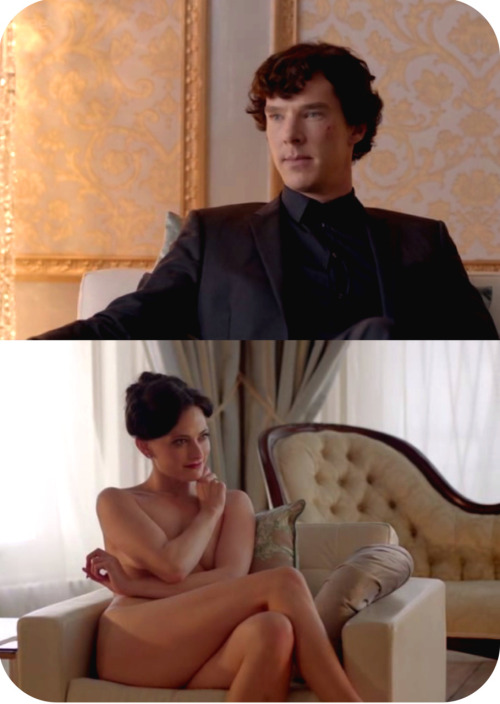
I wasn't able to watch 'Scandal in Belgravia' in real time last night, because I had to work. But it was recorded for me, and except for cutting out about five minutes to the end right after Mycroft and John were talking and John is told Irene Adler was caught and killed, I got to see the entire thing.
I can't wait till the end of the month when I can get these on DVD and watch them over and over and obsess about the end of the Reichenbach Fall.
I thought this was a strong episode to start out with for Season Two, though a couple of things bothered me. I actually really liked how things in the pool wound up (Stayin' Alive? Seriously???), but at the same time, the overall mystery bugged me a bit. In the first season, each episode had its own mystery, found and solved within the time frame of the episode, with the underlying threat of Moriarty being the one in the background, pulling the strings of the different people involved.
This one, you knew Moriarty was involved, you knew his hand was in it, but at the same time, it was so much more than that. More than just an underlying threat, I got the sense that Sherlock was just a pawn in a huge game of chess going on, that he's honestly completely unaware of. Well, after this episode, not completely unaware, but only minimally.
And what the heck is Mycroft into? Something shady is definitely going on with him. It's like he's picked out a direction he wants Sherlock to go, and is doing everything he can to lead him that way. Which, considering how this season ends, may absolutely be the point.
I've seen different articles and whatnot about the third episode, The Reichenbach Fall, and one of them had a quote from the show's producer. Or writer, I can't recall which. It was someone involved with the show. Anyway, he said that despite everyone's guesses, everyone was missing one important clue concerning Sherlock's 'jump.' I'm not going to write about it now, but my mind's already piecing together possibilities. When the shows initially aired in England, I wrote up my own theories about the third episode. After The Reichenbach Fall airs on this side of the pond, I'll rewrite my theories (if they significantly change. If not, I'll simply overview them, and undoubtedly add a lot more since I'll have actually seen the episode now instead of relying on thirty second YouTube clips,) and post them in a new entry.
I honestly think one of my favorite parts of this episode was when Molly and the rest of them are gathered at Baker Street (why'd they not keep Sarah in the show? I liked her!) for Christmas and Sherlock goes through the whole, "Oh, Molly, you have a new boyfriend?" speech, then looks at the tag and sees the gift that started his whole deduction is for him.
I also loved how, throughout the episode, Irene Adler is trying her damnedest to get a rise out of him, but he refuses to take the bait. He's so stoic and controlled. I'm glad they didn't go into any kind of out-of-character stuff with Sherlock. They didn't have him drawn in by her feminine wiles. Yes, he was drawn in, but more because he was drawn to the case and trying to figure her out analytically. I can't help thinking that the entire time he was looking at her, all he saw were the question marks they showed the first time he looked at her.
And the difference between Irene Adler and Molly is so striking. On one hand, we have this poised, self-assured, beautiful woman who can pretty much make just about any man do whatever she wants them to. On the other, we have a woman who seems younger somehow, makes jokes about working with cadavers, and gives off the feeling of a little girl playing dress up with a big sister or mommy's clothes when she tries to look fancy.
Yet which one did Sherlock apologize to and give a kiss on the cheek?
Molly Hooper - 1
Irene Adler - 0
Subscribe to:
Posts (Atom)